 Michael’s Tree Felling
Do You Need Council Permission to Remove a Tree in Port Elizabeth?
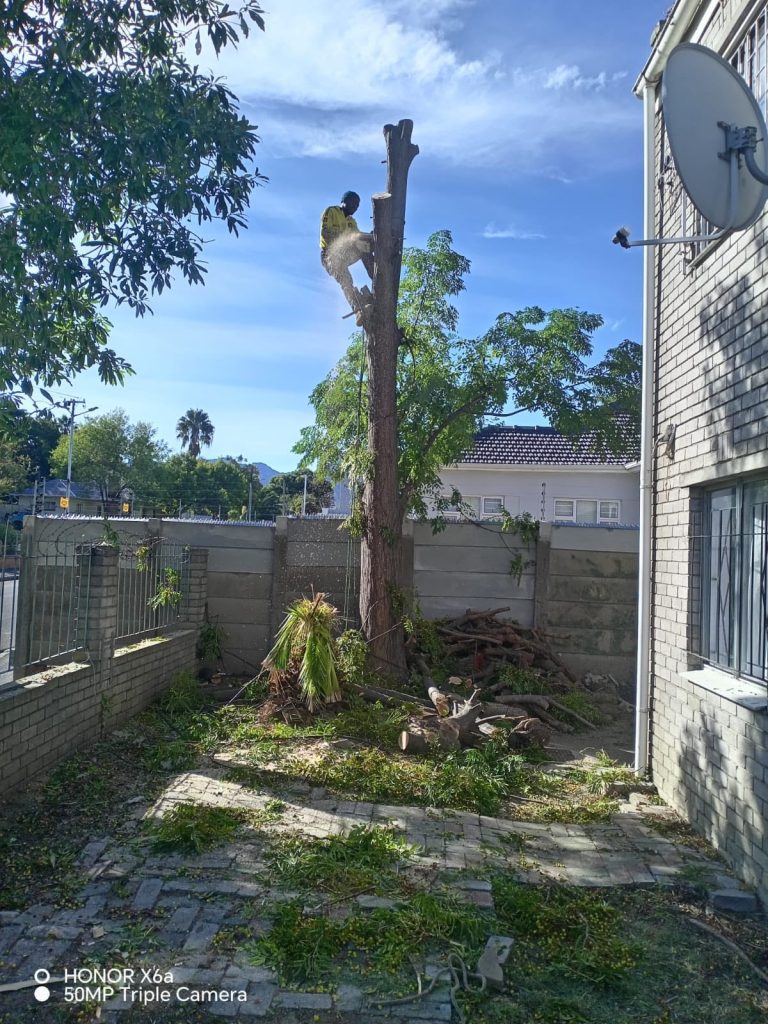
It depends on two separate things: where the tree is, and what species it is. A tree on the municipal verge needs written NMBM permission regardless of how long you’ve treated it as your own, and certain indigenous or protected species need a national Department of Forestry, Fisheries and the Environment (DFFE) licence even on your own property. Skipping either check before felling can mean fines exceeding R5,000 — a professional can confirm which rule applies, or if neither does, before you commit to anything.
If you’re staring at a tree you want gone and wondering whether you actually need permission first, the honest answer is: it depends on where the tree stands and what species it is and getting that wrong before you cut can cost more than the removal itself.
Two separate rules can apply, and they’re easy to confuse. One is about where the tree is (municipal verge vs. your own property). The other is about what the tree is (certain species are protected regardless of whose land they’re on). Here’s how to tell which one applies to yours, and what happens if you skip the check.
Not sure whether your tree is a verge tree or a protected species? Send a photo and location on WhatsApp and the team will check before you plan anything further.
Ask About Your TreeVerge trees are municipal property, not yours to remove
If the tree sits on the strip between your boundary wall and the road, the verge Nelson Mandela Bay Metropolitan Municipality (NMBM) classifies it as municipal property, full stop. It doesn’t matter that it’s shaded your stoep for twenty years or that its roots are the ones lifting your own paving; legally, it isn’t yours to fell or prune without written council permission.
This catches a lot of Port Elizabeth homeowners off guard, especially in older, leafier suburbs where street trees were planted decades before the current owner bought the house. The tree feels like part of the property. Legally, on the verge, it isn’t. Felling or heavily pruning it without going through NMBM first is a compliance risk regardless of how close to your boundary line it stands or how long your family has treated it as “ours.”
If you’re not sure whether a specific tree counts as a verge tree, that’s a question worth putting to the municipality or a professional before doing anything else not a judgment call to make from the driveway.
A second layer: protected species under the National Forests Act
Even if a tree is fully on your own property, a second rule can still apply. South Africa’s National Forests Act adds a layer on top of municipal control: certain indigenous and protected tree species require a licence from the Department of Forestry, Fisheries and the Environment (DFFE) before they can be removed, regardless of whose land they’re growing on.
This is the rule most homeowners have never heard of, because it isn’t about location; it’s about species. A protected tree in your own back garden can carry the same permission requirement as a municipal verge tree out front. Which species are protected, and under what conditions, is genuinely something to verify rather than assume — don’t take “it’s just a big old tree” as proof either way.
How to check if your tree is protected
There’s no shortcut that replaces an actual check. In practice, this usually means one of two things: getting the tree identified and cross-checked against the current protected-species list by someone who knows what they’re looking at, or contacting NMBM’s relevant department directly with photos and the tree’s location.
What’s not a reliable way to check: guessing from a gardening forum, assuming a tree isn’t protected because it’s common in the area, or assuming it is protected because it looks old and impressive. Size and age aren’t the test; species is. If a company quotes you for removal without first confirming whether the tree is regulated, that’s worth a second thought before you sign anything.
The application process and what to expect
Where permission is required, whether it’s an NMBM verge permit or a DFFE licence for a protected species, the general shape of the process is a written application describing the tree, its location, and the reason for removal, submitted to the relevant authority before any work starts. Processing isn’t instant: timelines vary depending on the specific approval required, the completeness of the application, and the municipality or department’s current workload, so it’s worth building that lead time into your plans rather than assuming a same-week turnaround.
This is exactly the kind of detail worth confirming with the municipality directly for your specific tree and situation, rather than relying on a general timeline from an article; requirements and processing capacity do shift.
What it actually costs to skip this step
The appeal of skipping the paperwork is obvious: permits take time, and a chainsaw doesn’t ask questions. But felling a regulated tree without the right permission isn’t a quiet risk. It’s the kind of compliance failure that can carry fines exceeding R5,000, on top of whatever it costs to make the situation right afterwards. For a tree that was going to need professional removal either way, that’s an expensive way to save a bit of paperwork.
There’s also a practical angle beyond the fine itself: if a permit was required and wasn’t obtained, that can complicate things down the line a property sale, a dispute with a neighbour, or a council follow-up. It’s a risk that’s straightforward to avoid and expensive to walk back.
How Michael’s handles this for you
This is exactly the part of the job that’s easy to get wrong on your own and straightforward for a team that does it regularly. Before quoting on a job, Michael’s Tree Felling identifies whether a tree is a regulated verge tree, a protected species, or neither — and if approval is needed, guides you through the correct process before any work starts, rather than leaving you to work out municipal and national requirements on your own.
Got a tree you’re considering removing and you’re not sure which rules apply? Michael’s can check the tree and the permission question at the same time — before you commit to anything.
Check My Tree & Permission Requirements →The team flags anything that needs NMBM or DFFE approval before you commit to anything, and quotes accordingly once that’s settled.
 Text For Same Day Quote