 Michael’s Tree Felling
A Fallen Tree After a Storm in Port Elizabeth: Your First 24 Hours
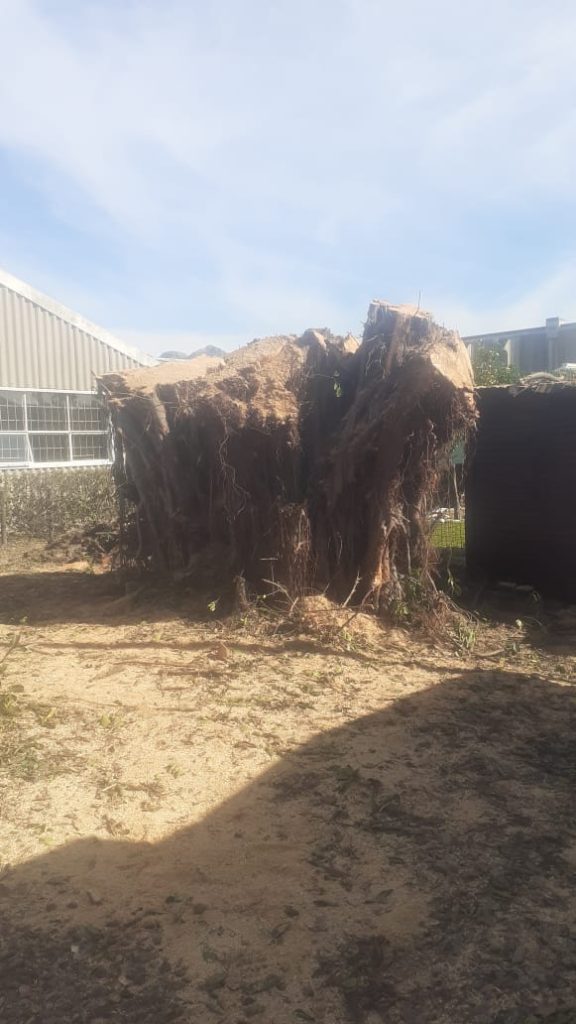
Safety first, then documentation, then removal. Stay well back from anything touching power lines and treat it as live. Once the area is safe, photograph the damage before anything is moved — this matters for insurance. Check with your own insurer (and the neighbour’s, if a boundary tree is involved) rather than assuming who pays, report it to NMBM if it’s blocking a road or on the verge, and book a same-day emergency callout to get it removed safely.
If a tree has come down on your property, a neighbour’s, or across the road after a storm, the priority order is simple: safety first, then documentation, then getting it removed properly. Trying to sort out who’s responsible or how much it’ll cost before the area is actually safe is the wrong order — and it’s the order most people default to under stress.
Here’s what to do in the first 24 hours, what to leave to professionals, and how to get it removed fast without creating a second problem.
1Immediate safety steps
If any part of the tree is touching a power line, cable, or pole — or you’re not certain it isn’t — treat the whole area as live and stay well back. Don’t touch the tree, any attached wires, or anything metal near it, and don’t let anyone else near it either. Downed power lines aren’t a tree-removal job; that’s a job for the power utility, and calling them (or your municipality’s emergency line) is the first call, not the last resort.
Beyond electrical risk, check for structural danger before going near the tree at all: is it leaning against the house, resting on a fence or carport under load, or blocking the only path in or out of the property. A tree that’s fallen but still partially supported by whatever it landed on can shift further with no warning. Keep people, pets, and vehicles clear of that zone until someone qualified has looked at it.
If the situation is urgent right now — a tree blocking your driveway, resting on a structure, or anywhere near power lines — call or WhatsApp for a same-day emergency response rather than waiting to figure out the rest below first.
Get Emergency Help Now2Photograph before you touch anything
Once the immediate area is safe, photograph the damage before anything gets moved, cut, or cleared — this is the single most useful thing you can do for whatever insurance claim follows. Get the whole scene from a few angles: the fallen tree itself, what it landed on or damaged, the stump or root plate if it uprooted, and anything nearby that shows how it fell (a snapped branch still in another tree, debris pattern, and so on). Insurers and any dispute over responsibility both go much more smoothly with this documented before cleanup starts than reconstructed from memory afterward.
3Who pays — your policy vs. the neighbour’s
This is genuinely one to check with your own insurer rather than assume, since home insurance policies vary in what they cover for storm and fallen-tree damage, and responsibility can depend on factors like whose property the tree was on, whose property it landed on, and whether the tree showed prior signs of being a known risk. Don’t take a general rule you’ve heard secondhand as settled fact for your specific situation — a call to your insurer, and to your neighbour’s if a boundary tree is involved, is worth doing early rather than after removal work has already started.
What’s usually true regardless of how the cost question resolves: photographing the damage first (above) and getting a clear, itemised quote for the removal work makes that conversation easier no matter who ends up covering it.
4When NMBM gets involved
If the fallen tree is blocking a road, sits on the municipal verge, or has taken down municipal infrastructure alongside it (streetlights, signage, verge trees themselves), Nelson Mandela Bay Metropolitan Municipality has a role to play — verge trees are municipal property, and a road-blocking tree is a public safety matter, not just a private one. Reporting it to NMBM alongside arranging private removal isn’t redundant; it’s the correct process when the tree or the obstruction extends beyond your own property line.
5Getting an emergency same-day callout
Once the immediate safety and photography steps are done, the fastest path to getting the tree actually removed is a same-day emergency callout rather than working through a standard quote process. Michael’s Tree Felling keeps emergency slots available across Port Elizabeth specifically for storm damage, driveway-blocking trees, and structural risk situations that can’t wait for a routine booking — call or WhatsApp with a couple of photos and the team can typically assess urgency and dispatch the same day.
6What “emergency response” actually includes
An emergency callout isn’t just showing up faster — it’s a crew equipped to handle a tree that’s already fallen and potentially still under tension or resting unpredictably on a structure, which is a different (and more hazardous) job than a planned removal. That means proper rigging and controlled cutting rather than just hacking the obstruction clear, full debris removal so the property isn’t left with a mess on top of the damage it already has, and a team that’s insured for exactly this kind of unpredictable, higher-risk work.
If you’re dealing with a fallen tree right now, Michael’s Tree Felling’s emergency response covers all of this — safe removal, full clean-up, and a same-day slot when the situation genuinely can’t wait.
Book Emergency Removal Now → Text For Same Day Quote