Palm Tree Removal in Port Elizabeth
We fell the palm tree section by section — walls, roofs, pools, and paving stay untouched, and haul off every frond and trunk piece all in one visit. On time, fair price upfront, yard left clean.
Call Now For Free Tree Assessment
12 Years Eastern Cape Experience
Same-Day Quotes via WhatsApp
Palm-Specific Rigging & Grinding Equipment
Port Elizabeth Palm Tree Removal
Michael’s Tree Felling removes palm trees across Port Elizabeth safely and legally, from small Cocos palms in Walmer gardens to 15-metre Washingtonias towering over Summerstrand complexes. Quotes are free and turned around within an hour of a WhatsApp photo. Same-day slots are held for storm-damaged and hazardous palms. Every job includes debris removal, and stump grinding is available on the same visit.




100+ Reviews
Why It’s Different
Palms Are Not Trees: Why Specialist Removal Matters
Palms look like trees, but the internal structure is closer to grass. The trunk is fibrous, densely packed with vascular bundles, and has no rings or heartwood. Standard tree felling technique fails on palms in three specific ways:
Fibrous trunk resists standard chainsaw teeth
Palm fibre dulls timber chains within minutes. Correct removal uses freshly sharpened chains rotated frequently or purpose-built palm cutting attachments.
Weight distribution is top-heavy
A mature Phoenix canariensis carries 200 to 400 kg of crown mass on a smooth, slick trunk. Notch-and-fell techniques used for oaks or bluegums will drop the crown unpredictably.
Trunk offers no lateral holding points
There are no branches to rig from. Every rigging point has to be strapped or bolted to the trunk itself, which requires spike-climb or MEWP access and palm-rated slings.
A palm dropped incorrectly onto a Summerstrand carport or a Humewood boundary wall causes damage that costs a lot of money. Every palm removal Michael’s takes on is planned to match the species, the height, the surroundings, and the access before a chain ever runs.
Species Guide
Palm Species We Remove Across Port Elizabeth
Port Elizabeth’s coastal climate and 1970s–1990s suburban landscaping choices left the city with a specific mix of palm species. Each has its own removal profile. Not sure what you’re dealing with? WhatsApp a photo — species identification is the first thing that determines the quote.
Washingtonia robusta
Mexican Fan Palm
Coastal
Dominates Summerstrand and Humewood beachfront. Reaches 20m. Dead frond “petticoat” is a fire hazard and rat harbourage; shallow root plates mean leaning after coastal storms. Usually, a spike climb with sectional trunk descent.
Phoenix canariensis
Canary Island Date Palm
Complex
Wide-crowned, heavy palm in Mill Park heritage gardens and older Walmer properties. Crown weight often exceeds 300kg; 30–40mm frond spikes and 5–10kg seed pod clusters. Always sectional removal.
Phoenix reclinata
Wild Date Palm — Indigenous
Protected
Multi-stemmed indigenous palm in Mount Croix, St George’s Park periphery, and Baakens Valley. Protected under the National Forests Act — removal requires a DFFE permit. Fines can exceed R5,000 per stem.
Syagrus romanzoffiana
Queen Palm
Invasive
Widely planted across 1990s–2000s Lovemore Heights, Charlo, and Framesby. Category 1b invasive under NEMBA in parts of SA. Self-seeding creates a legal control obligation — softer trunk, same top-heavy risk.
Cocos nucifera
Mixed Cocos Palms
Common
Ornamental garden palms across Newton Park, Charlo, and Sunridge Park. Usually 6–10m and often removable as a straight fell where drop zones allow.
Archontophoenix cunninghamiana
Bangalow / King Palm
Invasive (regional)
Present in newer Lovemore Heights and Kabega Park landscaping. Flagged as invasive in some regions. Straight-trunked, moderate weight, standard sectional removal.
Howea forsteriana
Kentia Palm
Common
Smaller specimen palms in urban Newton Park, Central, and Richmond Hill terrace gardens. Typically, a single-day visit with hand tools plus a chainsaw.
Signs Your Palm Needs to Come Down
Palms don’t always die dramatically. Watch for these signals; most of them are worse than they look.
What that experience looks like in Lorraine:
The central spear is brown or pulls out easily
In Washingtonias and Cocos, this signals lethal yellowing or bud rot — the palm is already dead structurally.
Trunk shows soft spots or oozing sap
Fungal decay of the internal fibre. Structural failure follows within one to two winters.
The palm is leaning further after every southeaster
Root plate is failing. Once movement starts, it accelerates.
The frond skirt is not being maintained
Dead fronds on a Washingtonia become fire fuel and rat nesting material.
Seed pod clusters on Phoenix canariensis
Each cluster weighs 5–10kg and drops without warning.
Palm is contacting roof gutters, cables, or walls
Cape Road and William Moffett corridor properties in particular.
Species is a declared invasive with a compliance notice
Queen palm, Bangalow, and Washingtonia in some zones.
The body corporate has issued an instruction to remove
Common in Summerstrand and Humewood beachfront complexes.
The Port Elizabeth Palm Tree Removal Process
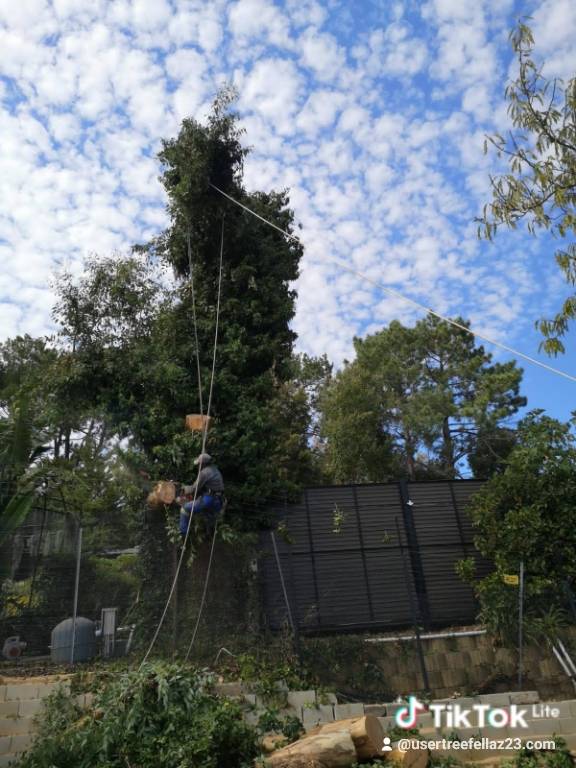
Every PE palm removal follows one of two approaches, decided on-site based on access and drop zone.
Sectional Rigging Removal
Used for palms in tight urban plots, over carports, near boundary walls, adjacent to pools, or under overhead cables. Standard for 90% of Summerstrand, Humewood, Central, and Mill Park removals.
1.
Site assessment and drop zone confirmation
2.
Drop zone cleared and covered with impact matting where paving is at risk
3.
Climber ascends via spikes with palm-rated saddle and lanyard
4.
Fronds cut and lowered on the rope one by one
5.
Crown removed as one piece or in sections, rigged and lowered
6.
Trunk cut in 1–1.5m sections from top down, each lowered on rope
7.
Trunk sections and fronds chipped where possible, loaded, hauled
8.
Site swept, driveway blown clean
Typical duration: 4–8 hours per palm depending on height and access.
Straight Fell
Used only where there is a confirmed clear 1.5× tree-height drop zone — rare in PE residential settings but common in Theescombe, Kragga Kamma, and edge suburbs bordering agricultural land.
1.
Directional notch cut on the fall side
2.
Back cut with wedges to control lean
3.
Palm falls in one piece
4.
Ground processing, chipping, load-out
30–40% cheaper than rigging, quoted only when genuinely safe.
We also offer tree felling, tree trimming and tree stump removal services in Port Elizabeth
Palm Stump Removal — The Second Half of the Job
A felled palm without stump grinding leaves you with a live root crown that:
Trips people
Attracts termites, ants, and rats
Regrows in the case of Queen palms and Washingtonias
Blocks any plans to re-turf, pave, or replant
Palm stumps need different equipment from timber stumps. Fibrous material resists standard tungsten-tipped grinding teeth and either surface-chips (leaving a live crown) or wraps around the cutter and stops the machine.
Michael’s uses palm-specific cutting heads, adjusts grinding speed for palm fibre, and grinds a minimum of 150mm below grade, extended to 250mm for Washingtonia and mature Phoenix stumps in coastal Summerstrand and Humewood soils, to kill the crown entirely.
Stump grinding on the same visit saves the second call-out fee — always ask for it in the initial quote.
Legal & Permit Context for PE Palm Removals
Three regulatory frameworks apply to palm removal in Port Elizabeth. Michael’s checks all three before quoting.
National Forests Act
Protected Indigenous Palms
Phoenix reclinata (Wild Date Palm) is protected. Removal requires written permission from DFFE.
NEMBA
Invasive Palms with a Legal Removal Obligation
Queen palm, Bangalow, and Mexican fan palm are variously listed as Category 1b or 3 invasives. A compliance notice from a landowner association or municipality creates a legal obligation to control — removal is the compliant path.
NMBM Verge Trees
Municipal Verge Palms
NMBM classifies road-verge palms as municipal property regardless of who planted them. Removal without written permission carries a fine and possible replacement order, common on older streets in Newton Park, Mill Park, and Cape Road.
Coverage Area
Palm Removal Across Port Elizabeth Suburbs
Palms in PE are not evenly distributed. Michael’s works across the whole city, but demand is heaviest in a defined coastal palm belt.
The Coastal Palm Belt
Summerstrand
Highest palm density in the city. Mature 1980s Washingtonia rows now 18–20m along Marine Drive complexes; tourist foot traffic near King’s Beach adds a constraint.
Humewood
Large Phoenix canariensis in older gardens and Washingtonia rows on complex boundaries. Seed-pod hazard is most acute here.
Lovemore Heights
Queen palms (invasive obligation) and 1990s Bangalows. Slope access often limits cherry picker use.
Beachview & Sardinia Bay
Isolated properties with older Washingtonia and Cocos planting; straight fell more often possible.
The Older Inland Suburbs
Mill Park
Heritage Phoenix canariensis in mature gardens; MEWP access usually required.
Walmer
Mixed Phoenix and Cocos palms, mostly rigging removals on tight plots.
Newton Park
Mostly smaller Cocos and Kentia palms, occasional Phoenix removals.
Charlo & Sunridge Park
1980s–1990s Queen palm and Bangalow planting reaching invasive-obligation stage.
The Wider Metro
Kabega Park, Framesby, Kragga Kamma, Bluewater Bay, Colchester, Motherwell, Central, Richmond Hill, Mount Croix, Mount Pleasant, Lorraine, Theescombe — Michael’s covers the entire Nelson Mandela Bay Metropolitan area.
Complex & Body Corporate
Body Corporate & Complex Palm Work in PE
A significant share of PE palm removal work happens in Summerstrand, Humewood, and Sunridge Park body corporate complexes. Common palm liability scenarios:
Liability scenarios
Frond drop over shared parking — a Washingtonia frond weighs 8–15kg dry
Seed pod drop on Phoenix palms — higher damage per event
Leaning palms threatening a boundary wall or neighbouring roof
Fire risk from unmaintained frond skirts in beachfront blocks
Michael’s provides
Written itemised quotes for trustee sign-off
Method statement for common-property or vehicle-proximity jobs
Clean-up sign-off documentation for AGM records
Scheduling around resident notice periods
On the Day
What to Expect on the Day
Arrival window
A two-hour window confirmed the day before; the team calls 30 minutes out.
Crew size
3 to 5 crew depending on complexity — one climber, one on rigging, one to two on debris.
Vehicle
LDV plus trailer for standard jobs; tipper truck for large loads.
Duration
Small palms 2–3 hours. Mature Phoenix or Washingtonia 4–8 hours. Multi-palm jobs, full day.
Debris
All fronds, trunk sections, and crown material removed the same day — nothing left “for later”.
Access
Driveway access or on-street parking within 30m of the palm, confirmed on quote.
Cleanup
Site swept, driveways and paving blown clean, surfaces washed if resin or sap has landed.
Why Choose Us
Why Michael’s for Palm Work in Port Elizabeth
12 years working with PE palms specifically — the species mix in Nelson Mandela Bay differs from Cape Town or Durban.
Palm-specific equipment: cutting attachments, palm-rated slings, palm-grinding heads.
WhatsApp-first quoting — photo in, quote out, usually within the hour.
Same-day storm response for palm crown failures during the southeaster season.
Stump grinding on the same visit, with palm-specific heads.
Frequently Asked Questions
How long does palm tree removal take in Port Elizabeth?
Most single-palm removals in PE are completed the same day. Small Cocos or Kentia palms take 2-3 hours. Mature Washingtonias and Phoenix canariensis take 4-8 hours, depending on rigging complexity. Multi-palm complex jobs are typically full-day work.
Do I need a permit to remove a palm tree in Port Elizabeth?
It depends on species and location. The indigenous Phoenix reclinata requires a National Forest Act permit. Palms on NMBM road verges require municipal permission. Invasive species like Queen palm and Bangalow don’t require a removal permit; the law encourages their removal.
Can you remove a palm without damaging my pool or paving?
Yes, sectional rigging removal is designed for exactly this scenario. Every frond and trunk section is roped down under control. Impact matting is used where paving is at risk. Michael’s has removed palms from over pools, patios, and heritage paving across Summerstrand, Humewood, and Mill Park without incident.
What happens to the palm stump?
Stump grinding is a separate line item but is typically included on the same visit. Palm stumps require palm-specific cutting heads on the grinder; standard timber-stump equipment surface-chips palm fibre instead of grinding it. Michael’s grinds to a minimum of 150mm below grade, 250mm for coastal-suburb Washingtonias and mature Phoenix palms.
Do you remove Queen palms and other invasives?
Yes. Queen palm (Syagrus romanzoffiana), Bangalow (Archontophoenix cunninghamiana), and Mexican fan palm (Washingtonia robusta) are all removable without a permit. NEMBA classifies these as invasives requiring control; removal is the compliant approach.
Is emergency palm removal available?
Yes. Storm-damaged palms, actively leaning palms, and crown failures are handled with same-day slotting. Emergency rate is a 25% surcharge on the standard removal price. WhatsApp the situation, and the team responds within the hour.
Get a Palm Removal Quote in Port Elizabeth
Send a photo of your palm to Michael on WhatsApp, along with a note on what’s around it — wall, pool, cable, roof, driveway. A quote and available dates will come back within the hour. Same-day slots are held for hazardous palms.
Call Now For Free Tree Assessment
 Text For Same Day Quote