This is general information. Tree species and legal status should be confirmed on site before any work.
The short answer
Gum trees (eucalyptus) aren’t native to South Africa. They were brought from Australia in the 1800s for timber, fuel and windbreaks. Six gums are listed invasive species under South Africa’s biodiversity law, including river red gum and sugar gum. Blue gum, the best-known gum, is not on the 2020 national list. Whether a listed gum on your property must be controlled depends on where it grows, and whether it should come down usually depends on its size, condition and how close it is to your house.
Jump to:
- Are eucalyptus trees native to South Africa?
- Which gum trees are invasive in Cape Town?
- Is blue gum invasive?
- How to tell common gums apart
- Why big gum trees are a risk near houses
- Should you remove a gum tree?
- What removing a large gum involves
Are eucalyptus trees native to South Africa?
No. All eucalyptus species come from Australia and nearby islands. South Africa has no indigenous gums. Gums were planted widely in the 1800s and 1900s for timber, poles, firewood and windbreaks, which is why old rows of very tall gums still line farm boundaries, avenues and older suburban properties around Cape Town.
Which gum trees are invasive in Cape Town?
Six gums are listed under NEMBA, and all six share the same location-based rules in the 2020 Alien and Invasive Species Lists:
| Listed gum | Scientific name |
|---|---|
| River red gum | Eucalyptus camaldulensis |
| Sugar gum | Eucalyptus cladocalyx |
| Spider gum | Eucalyptus conferruminata (called E. lehmannii in South Africa) |
| Karri | Eucalyptus diversicolor |
| Saligna gum, rose gum | Eucalyptus grandis |
| Forest red gum | Eucalyptus tereticornis |
For these six, the rules are:
- Category 1b in riparian areas, in protected areas and listed ecosystems, and across biomes including fynbos, which covers much of Cape Town.
- Category 2 for plantations, woodlots, bee-forage areas, windrows and avenues.
- Not listed in urban areas for trees with a trunk diameter over 400 mm at 1 m height when the list was published (September 2020), unless the tree is in a riparian area, a protected area or a listed ecosystem.
In practice, a large, established sugar gum in a suburban Cape Town garden is often not a listed invasive. A young one, or any listed gum along a stream or next to a nature reserve, usually is Category 1b and must be controlled. For what Category 1b and 2 mean for an owner, see our guide to invasive trees in Cape Town.
Is blue gum invasive?
Blue gum (Eucalyptus globulus) is not on South Africa’s 2020 national list of invasive species under NEMBA, even though it’s often described as invasive. Neither are ornamental gums such as the penny gum or silver dollar gum (Eucalyptus cinerea). Not being listed means there’s no NEMBA duty to control them. It doesn’t make a big blue gum safe next to a house. Size, condition and position still decide whether it should stay.
How to tell common Cape Town gums apart
Gums are hard to identify from leaves alone. Bark, the shape of the seed capsules (“gumnuts”) and where the tree grows are more useful:
- Blue gum: long strips of bark peeling from a smooth pale trunk, and large, warty, single gumnuts. Young regrowth has broad, blue-grey, waxy leaves.
- Sugar gum: smooth bark shedding in patches, leaving a mottled cream, yellow and grey trunk. Often planted in old rows and windbreaks.
- River red gum: smooth white-grey bark with darker patches, usually near rivers, dams or low-lying ground. Small gumnuts.
- Spider gum: a smaller, often multi-stemmed tree with gumnuts fused into spiky, spider-like clusters.
If the species matters (for example because the tree is near a stream or you’re selling), upload clear photos of the bark, leaves and gumnuts to iNaturalist or iSpot, or have it identified on site.
Why big gum trees are a risk near houses
Mature gums in Cape Town gardens are often well over 20 m tall, far bigger than most garden trees, and several of their habits matter when they grow near buildings:
- Limb drop. Gums are known for shedding large branches, sometimes in calm weather and without obvious warning signs. A single limb from a mature gum can be heavy enough to damage a roof or a car.
- Fire. Gum leaves are oil-rich and the bark sheds in loose strips, so gums burn intensely and can carry fire into the canopy. This matters most on properties near the mountain and urban edge, such as Noordhoek, Tokai and Constantia.
- Roots and water. Gums are thirsty, fast-growing trees with extensive root systems. Close to a house they can contribute to damage to paving, boundary walls and drains, particularly in dry summers.
- Debris. Constant bark, leaf and gumnut drop blocks gutters and pool filters.
Signs a gum needs a professional look: dead or hanging branches, cracks or splits in the trunk or main forks, lean that has increased, fungal growth at the base, or heaving soil around the roots.
Should you remove a gum tree?
Whether a gum should be removed depends on the tree and the site, not just the species. Removal is usually worth considering when:
- It’s a listed gum in a Category 1b situation (young, near a stream, or next to a protected area). Control is a legal duty; for a tree, control usually means removing it and following up on regrowth.
- It’s large and close to a house, road or neighbour’s property, and it overhangs roofs, cars or play areas.
- It shows structural defects such as splits, decay or dead limbs.
- It’s on a property on the fire-prone urban edge.
Before any gum is felled, check that it isn’t a National Heritage Tree, isn’t on City land (street and verge trees belong to the City), and doesn’t sit in a Heritage Protection Overlay Zone. See when you need a permit to cut down a tree.
What removing a large gum involves
A mature gum near a house is rarely felled in one piece. It’s taken down in sections from the top, with heavy limbs lowered by rope so nothing drops onto roofs, walls or gardens. Gum wood is dense and heavy, and dead gum wood can be brittle, so the work needs climbers experienced with big trees. Don’t attempt it yourself. If any part of the tree is near power lines, the electricity supplier must make the lines safe before work starts.
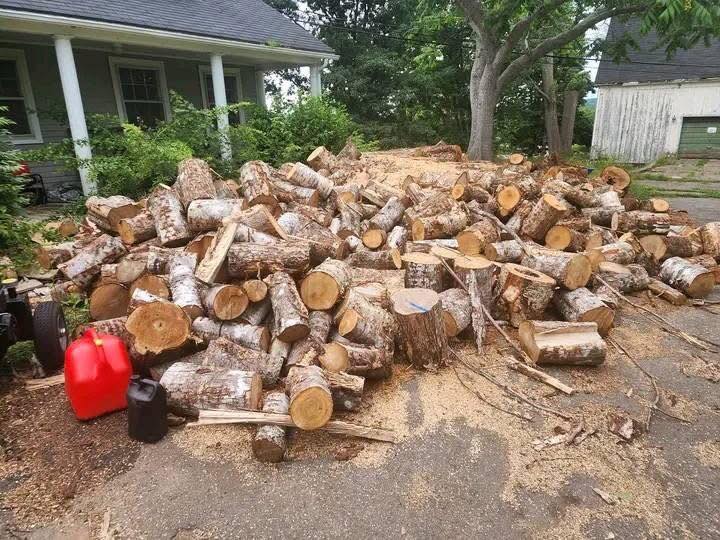
Many gums resprout vigorously from a cut stump, so the stump needs to be ground out or followed up; see tree stump removal in Cape Town. The timber and branches are chipped and removed, or cut into firewood lengths if you’d like to keep them.
Michael’s Tree Felling removes gum trees, including large invasive gums, across Cape Town, and has done since 2014. For a free quote, see tree felling in Cape Town or call +27 81 381 3804.
Sources: Alien and Invasive Species Lists, 2020 (Government Gazette 43726, GN 1003), entries 133–138; Alien and Invasive Species Regulations, 2020 (Government Notice R1020).
Last updated: 23 September 2026
 Chat with us